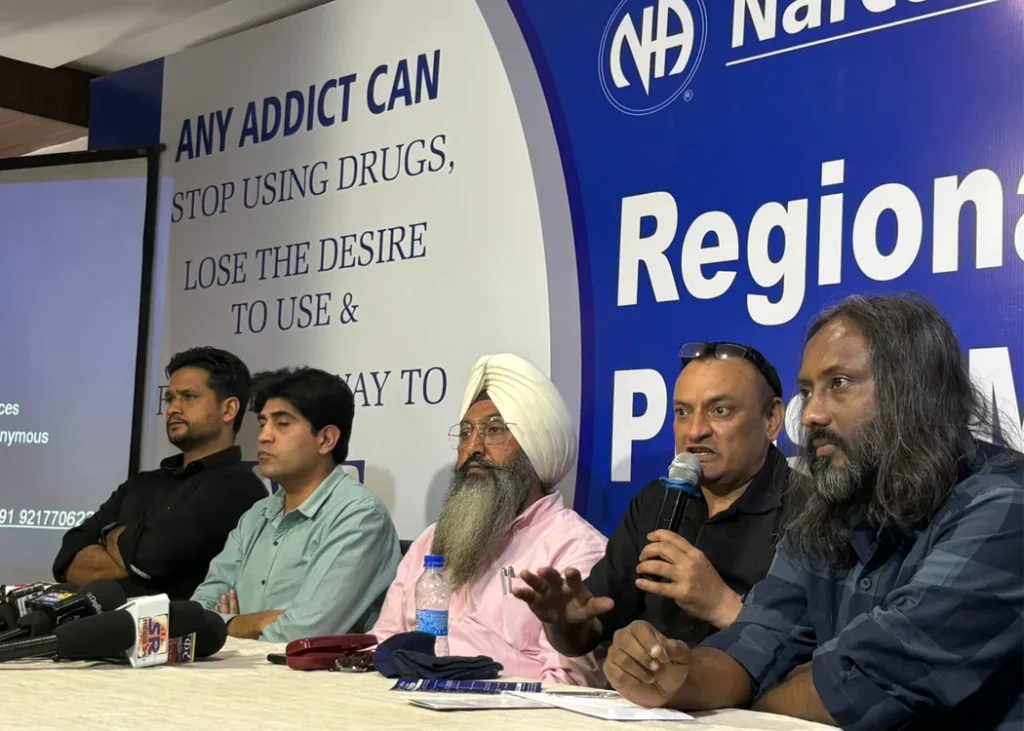
Narcotics Anonymous India highlights de-addiction efforts, announces three-day regional conference in Chandigarh. Chandigarh, March 9: The Society of Service Narcotics Anonymous (SOSONA), also known as Narcotics Anonymous (NA) India, highlighted its ongoing efforts to support people struggling with drug addiction and announced a Regional Table Conference during a press conference held at the Chandigarh Press Club, Sector-27 on Monday. The organization informed that the three-day conference will take place from March 9 to March 11 at Kisan Bhawan in Sector-35, Chandigarh. Volunteers and members of Narcotics Anonymous from different parts of the country are expected to participate in the event. The conference will focus on strengthening de-addiction services, expanding awareness campaigns, and spreading the message of hope and recovery among people battling substance abuse. Speaking on the occasion, SOSONA Chairperson Karamveer Singh said the organization remains committed to spreading a simple yet powerful message of recovery. He emphasized that Narcotics Anonymous believes any person struggling with addiction can stop using drugs, overcome the desire to use, and find a new way to live. “Through events like the Regional Table Conference and continuous community efforts, we want to ensure that people struggling with addiction know that recovery is possible and help is available,” he said. Narcotics Anonymous is a global non-profit fellowship where individuals recovering from addiction support each other through a 12-step recovery program. The organization works on the principle that “one addict helps another addict,” with mutual support, shared experiences, and encouragement playing a key role in recovery. Membership is open to anyone who wishes to stop using drugs, and there are no membership fees. Globally, Narcotics Anonymous conducts over 72,000 weekly meetings across more than 140 countries, making it one of the world’s largest peer-support recovery networks. In India, NA began in 1983 with the first meeting in Mumbai, and the network has steadily expanded over the past four decades. Currently, 299 groups across the country conduct around 471 weekly meetings, helping thousands of individuals move toward a drug-free life. According to Sumit, Area Public Information Chair of Chandigarh, the network has also grown significantly in the Tricity region. Presently, eight active groups in Chandigarh, Mohali, and Panchkula conduct 17 meetings every week. Each meeting typically sees 40 to 50 participants, while six to eight new individuals regularly begin their recovery journey. More than 275 members in the region have long-term clean time and service experience, providing guidance to others in recovery. Meetings are organized at multiple locations across Chandigarh, Mohali, and Panchkula to make them accessible. In addition, the Unity Group hosts online meetings daily from 6:30 pm to 8:00 pm, allowing people to connect virtually. The Chandigarh Area Service Committee works through various subcommittees to reach institutions and communities. The Hospitals and Institutions Subcommittee conducts meetings every week at five locations, including PGIMER Chandigarh, Government Medical College and Hospital Sector-6 Panchkula, SPYM Sector-18 Chandigarh, and SPYM Sector-66 Mohali. A new meeting will also begin at Civil Hospital Ropar on Saturdays, further expanding outreach to people undergoing treatment or rehabilitation. Meanwhile, the Public Relations Committee runs awareness campaigns across Chandigarh, Mohali, and Zirakpur. Volunteers distribute posters, flyers, and stickers and organize community events. Recent initiatives include awareness programs at Ramdarbar Phase-2, Tiranga Park Sector-17 under the “Drug-Free Chandigarh” campaign with the Social Welfare Department, and a presentation conducted in collaboration with NCC at GSSSG College Sector-42. The organization also collaborates with social welfare departments in Chandigarh and Haryana under the “Nasha Mukt Bharat Abhiyan.” Awareness programs are conducted in schools, colleges, hospitals, Ambala Central Jail, Model Jail Burail, juvenile homes, and rural areas of Panchkula, Ambala, and Yamunanagar. In Mohali, awareness activities are also conducted at Opioid Agonist Treatment clinics in partnership with the health department. To assist people seeking help, Narcotics Anonymous Chandigarh has launched a helpline (+91 92177 06222) that receives around 30 to 35 calls every month, providing information about meetings and recovery support. The organization is also active on Facebook, Instagram, and Twitter, enabling individuals seeking help to connect easily with the recovery community. Members of the organization said their continuous meetings, institutional collaborations, and awareness programs aim to ensure that every person struggling with addiction receives the message that recovery is possible and help is available. For more information, people can visit www.naindia.in or www.nachd.in.