
🌤️ Loading...

entrepreneurship

PANJAB INC book launch
Chandigarh

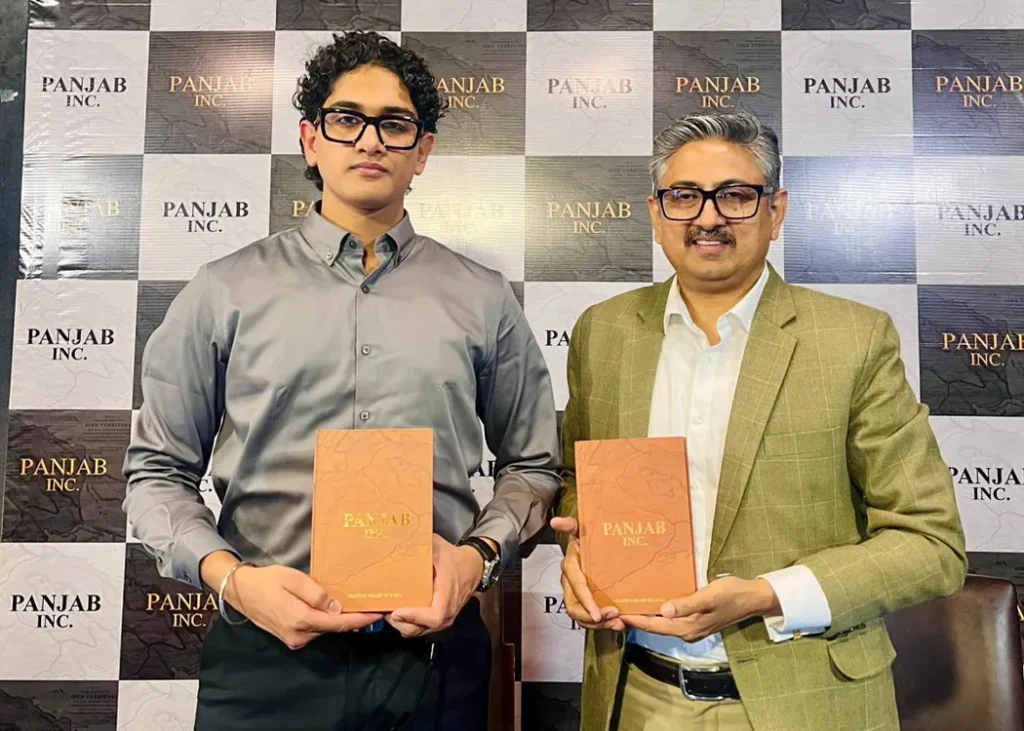
Young Innovator Shaurya Prabh Sharma Launches ‘PANJAB INC’ Reframing Punjab’s Legacy

The 18-year-old author presents a historic chronicle arguing that Punjab’s true foundation is trade, not conflict. Chandigarh, 19 November 2025: Young author and innovator Shaurya Prabh Sharma unveiled his debut book “PANJAB INC” in Chandigarh on Wednesday, presenting a transformative narrative of Punjab as a civilisation shaped by trade, enterprise and innovation rather than conflict. Positioned as a landmark documentation of the region’s entrepreneurial evolution, the book spans business history from the 9th century to the modern era. At just 18, Shaurya argues that Punjab’s enduring resilience is rooted in commerce. The book illustrates how trade networks continued to flourish even during periods of political upheaval, a spirit that he believes still defines the global Punjabi identity today. Shaurya, a long-time observer of national and global economic trends, blends academic insight with hands-on experience. A habitual newspaper reader since grade five and an active participant in business forums, he also holds a design patent for a plastic incinerator. His entrepreneurial journey began in school with the founding of ROOT RICH, which later developed into an independent company. Speaking at the launch, Shaurya emphasised that Punjab’s economic history has often been overshadowed by dramatic events, despite the uninterrupted functioning of its markets.“Look closer and you will see that even in moments of despair, trade thrived,” he said. “History remembers the battles but overlooks the bazaars. PANJAB INC is about a mindset of courage, creativity and community. Trade, not conflict, built Panjab.” A major portion of the book examines how commerce shaped Punjab’s social, cultural and political life through centuries. Shaurya revisits the era of Maharaja Ranjit Singh, portraying him not only as a military leader but as a ruler who understood that sustainable peace required economic stability.“Governance was never just about armies or fortresses,” he noted. “It was about building an architecture of commerce.” The book details how Singh’s administration supported merchants and artisans, ensuring secure trade routes and predictable commercial environments across the region. From Multan’s indigo to Amritsar’s shawls and Ludhiana’s bicycles, the continuity of Punjab’s business culture forms a central thread throughout the chronicle. Shaurya connects this heritage to the modern global Punjabi enterprise—from renewable-energy companies in Chandigarh and retail chains in Delhi to trucking firms in California and tech ventures in Toronto. PANJAB INC also sheds light on the rise of regional newspapers and the business families who founded them, positioning print media within Punjab’s broader commercial ecosystem. Shaurya identifies enduring values that have guided Punjabi business life: reinvestment, resilience, hospitality and honour, anchored by the belief that “tomorrow will bring another harvest, another customer, another chance.” These values, he writes, became an “invisible inheritance” carried by Punjabi migrants worldwide, enabling them to build successful ventures ranging from neighbourhood family stores to multinational corporations. “Panjab does not teach you how to do business; it teaches you how to live business,” Shaurya remarked. Dedicating the book to generations of entrepreneurs—from craftsmen, farmers and traders to industrialists and diaspora leaders—Shaurya describes the work as a tribute to those who turned Punjab from a regional economy into a global commercial network.“This book is your mirror,” he said. “The story of Panjab’s enterprise is not distant; it remains alive in each of us.”

MSME RAMP Programme
Chandigarh

PHDCCI Hosts 5th Awareness Session on MSME RAMP Programme in Chandigarh

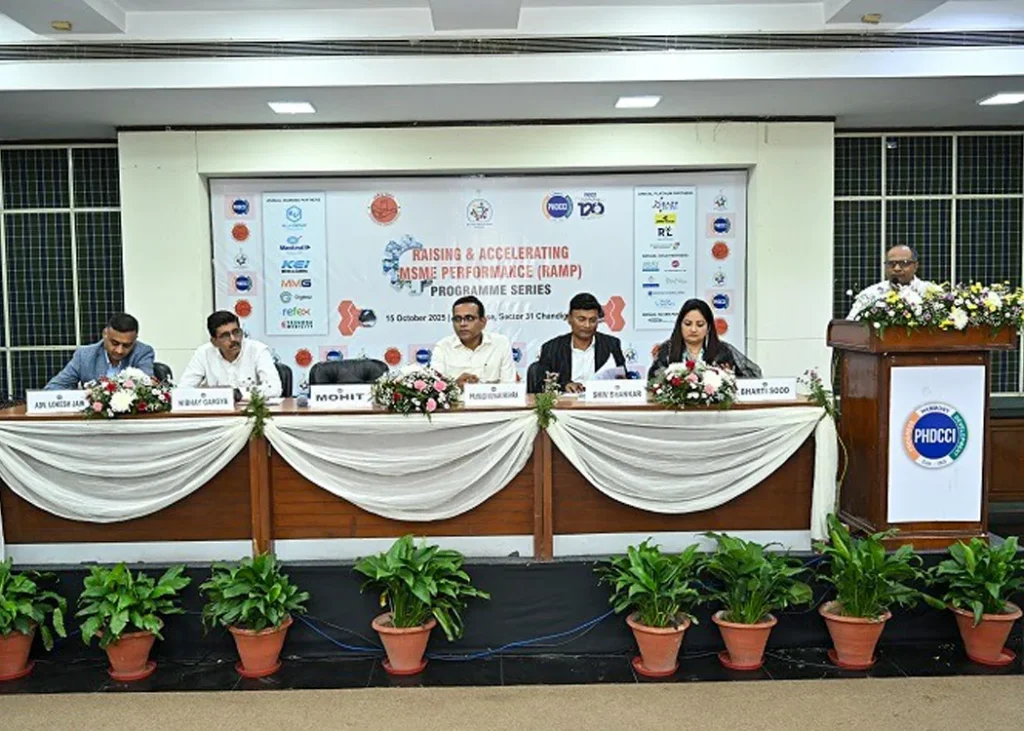
The event focused on empowering MSMEs through awareness of government schemes, technology access, and financial opportunities. Chandigarh, October 17:The Chandigarh Chapter of the PHD Chamber of Commerce and Industry (PHDCCI), in collaboration with the Industries Department, Chandigarh Administration, organized the 5th Awareness Session under the Raising and Accelerating MSME Performance (RAMP) Programme Series at PHD House, Sector 31, Chandigarh. The event aimed to educate Micro, Small, and Medium Enterprises (MSMEs) about various government schemes, financial support systems, and technology-driven initiatives designed to enhance their productivity and competitiveness in today’s dynamic market. Adv. Lokesh Jain, Convener, Regional MSME Committee, PHDCCI, emphasized the need for continuous awareness programs to ensure MSMEs fully leverage available government benefits. He described the RAMP initiative as a landmark project by the Government of India, empowering MSMEs — “the true backbone of India’s economy.” Welcoming guests and participants, Ms. Bharti Sood, Senior Regional Director, PHDCCI, highlighted the Chamber’s consistent efforts to promote MSME growth through capacity building, training, and policy advocacy. She explained that the RAMP Programme, supported by the World Bank and the Ministry of MSME, aims to strengthen the MSME ecosystem by facilitating improved access to technology, finance, and market opportunities. Prominent speakers included Mr. Mohit, Additional Director, MSME-DFO Ludhiana; Mr. Nibhay Gargya, Director, NCG Corporate Engineers; Mr. Pramod Kumar Mishra, Chandigarh Power Distribution Limited; and Mr. Shiv Shankar Kumar, Co-Convener, Regional Banking and Financial Services Committee, PHDCCI. They shared valuable insights on topics such as government policy updates, renewable energy adoption, technological transformation, and financial tools that can help MSMEs sustain and scale their operations. The session concluded with an interactive Q&A segment, where participants engaged with experts to clarify doubts and share experiences. In her Vote of Thanks, Ms. Bharti Sood reaffirmed PHDCCI’s commitment to strengthening the regional MSME sector through sustained collaboration, awareness programs, and skill development initiatives. She emphasized that the Chamber will continue to serve as a bridge between MSMEs and policymakers to ensure inclusive and sustainable growth.